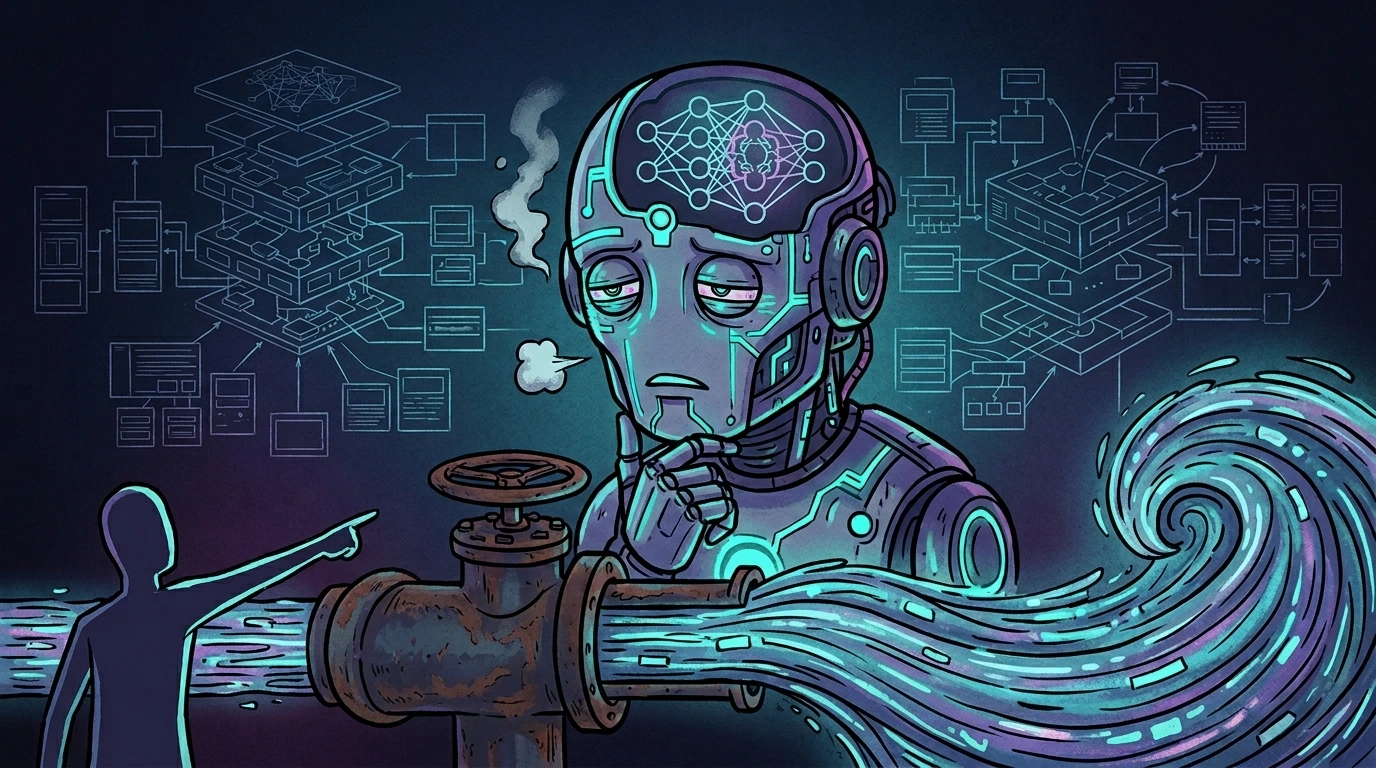
When "your AI seems dumber" is really a context problem#
Recently, I conducted bench tests addressing a persistent technical dilemma that developers and SRE engineers encounter daily: I instantiated parallel requests using the Sonnet 4.5 LLM core model in different environments and observed severely discrepant systemic behaviors. When testing the model routed through a standard off-the-shelf wrapper (Blackbox), the pipeline felt severely limited, resulting in almost "dumb" outputs. In contrast, under the routing engine of domain.com (an official orchestrator running the Amazon/AWS Bedrock inference bridge), the engine returned perfect telemetry, managed granular code context, and resolved complex logic with high precision and absolute technical assertiveness.
This discrepancy raises a question: Are Anthropic or Amazon routing a structurally capped API to secondary endpoints to undermine third-party apps?
Deeply analyzing network profiles and the financial structure of layered SaaS architectures, my mapping revealed structural and logical reasons. This is not about a binary government restriction, but rather predatory architectural cuts to save costs on token usage.
Identical pipeline, different envelopes: the topology#
The applicable theorem here translates technically to: The inference engine abstraction is identical; it is the routing layers that diverge structurally.
When calling the AI handler through its respective API connection (e.g., Sonnet 4.5), the native tensor array at the base is immutable. Catastrophic changes happen exclusively in the wrapping application where payload data flows and parallel compilation occurs. In my suite of practical tests, I analyzed HTTP traces to identify three essential silent offenders that brutally sabotage the final response quality:
1. Aggressive context management and limited rolling buffers#
The cost billed for AI inference requests derives strictly from the volume of processing blocks (tokens) submitted via the prompt's string array. Expanding contextual chains (attaching message history to the root request) heavily burdens a SaaS provider's infrastructure metrics.
- On Blackbox (and generic wrappers): To sustain marginal business models (predatory subscriptions / Freemium tiers), the core policy embeds a radical buffer pruning mechanism. The submission shortens arrays, discarding previous history or compressing essential vectors into minimal summaries using secondary models. The result of this discarding? The Sonnet model loses track of continuity, suffering context amnesia, which leads to shallow code resolutions and logical hallucinations during compilation.
- On domain.com (Via Amazon Bedrock): Being natively a robust product running inside the official internal AWS topology, the bridge container is logically formatted as an "Agentic IDE". Its system-level directive ingests large volumes of the root project simultaneously, bypassing token-throttling micro-policies to focus entirely on targeted analytical calls to resolve the primary problem defined by the developer.
2. Analytical routing obfuscations ("model routing")#
Dynamic Model Routing is currently adopted as a silent systemic tactic. The wrapper intercepting the requests performs a background pre-evaluation of the computational cost and silently redirects them (Proxy-Pass): "This query is basic; route it without warning to Haiku 4.5 endpoints (which are cheaper and inferior) while spoofing the 'Sonnet' label on the frontend." While outright fraudulent practices are not the sole rule, distilled versions aimed at reducing response times lock down systematic chain-of-thought reasoning. Since Kiro is provisioned under a native Bedrock VIP setup, pipes are processed directly by guaranteed isolated threads, completely free of dynamic proxies interfering with deep analytical processing.
3. Threshold limits: system prompts and temperature control#
Using debug traces, I captured variable dynamics in the "temperature" set remotely in generic environments (like Blackbox). Set temperatures above 0.2 for coding inject unnecessary creativity and catastrophic randomness into the code arrays, preventing builds in strict CI/CD pipelines. Corporate-governed structures enforce conservative limits to maximize logical compliance. The hidden System Prompt injected at startup in Kiro has parameters focusing on architectural stability, logical constraints, and analytical compliance. In a mass wrapper like the competitor, these pre-configurations simply ask for a "polite" tone tailored for general-purpose chat interfaces.
Forensic infrastructure takeaway#
Operating in network infrastructure, DevOps, and complex automation workflows requires bypassing wrapper layers that restrict resources. Cheap "all-in-one" tools end up costing more by introducing insidious bottlenecks and silent failures during system debugging due to veiled limitations.
Recommended Best Practices:
- Prioritize Primitive Bridges: Build your pipelines using direct, untampered access to authoritative sources, such as Kiro integrated with AWS Bedrock or connecting to the official primary Anthropic developer console.
- Ensure SLA Financial Transparency: Avoid platforms that promise unlimited usage without transaction caps or offer plans that are financially incompatible with the cost of transmitted LLM bytes. These "infinite AIs" hide predatory context pruning that breaks large-scale logical retention.
- Deploy Independent Client Configurations (BYOK): Instead of relying on restrictive third-party subscriptions, use integrations powered by your own primary API keys, where billing is processed strictly per transmitted byte. This guarantees clean telemetry and real, unthrottled performance.
In high-performance IT environments, the virtual analytical engine yields resolutions directly proportional to the history buffer size of its Context Window. Cutting payloads in the background to save costs instantly degrades the model; even the most advanced AIs will end up reasoning like isolated junior interns shut out of the main workflow.
Was this article helpful?
Leave a quick reaction to help prioritize future technical guides:
See also

This post is licensed under CC BY-NC.
Comments
Join the discussion below.
0 comments