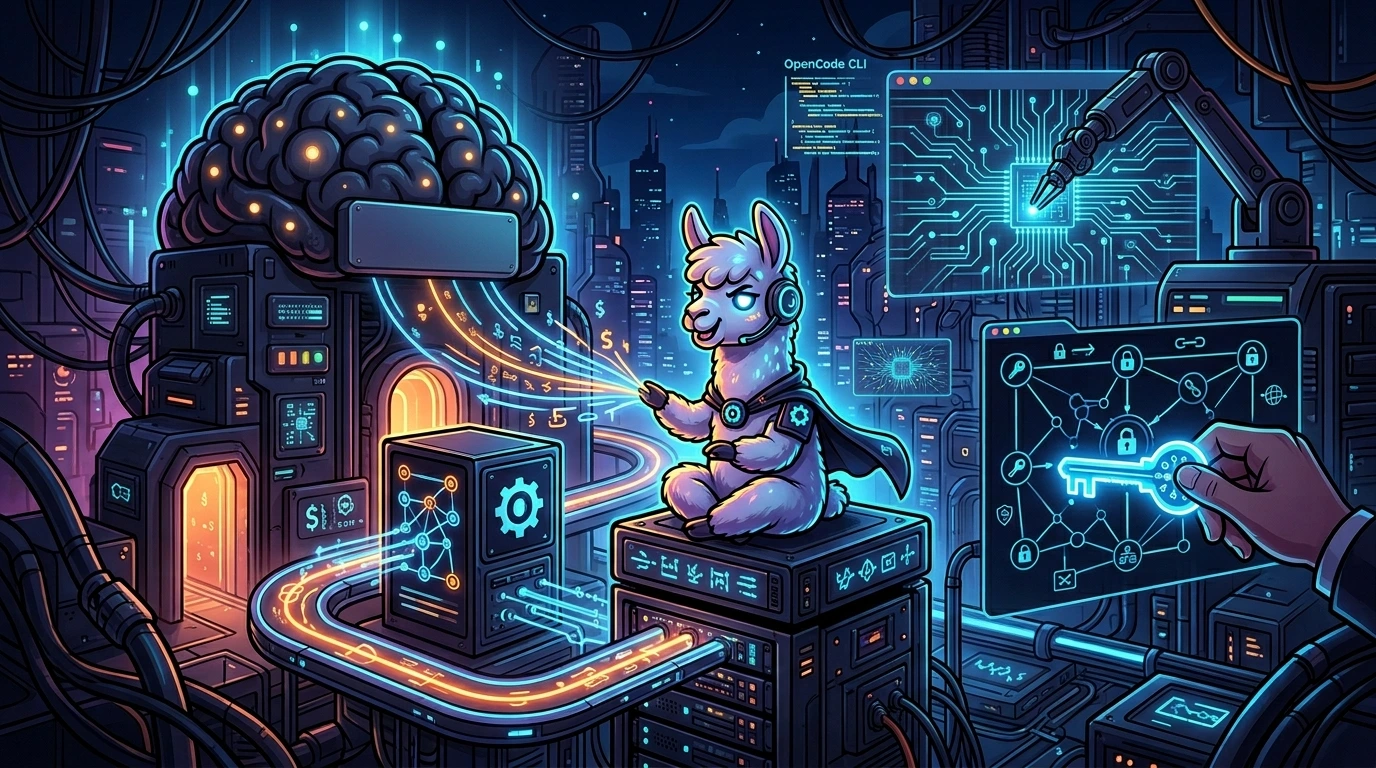
Opencode CLI, BYOK & Ollama: the real scenario#
The hyper-ascending traction of generative models has severely inflated software engineering dependencies on Copilot pipelines. Faced with these compulsory vendor lock-in injections via closed interfaces (Claude Code, GitHub Copilot CLI), the organic rise of open-source terminal tools tied to agnostic frameworks has forced an analytical breakdown: Does the hype support the technical traffic? And how can the scaling costs of these restrictive token-based requests be mitigated?
I systematically analyzed the architectural framework behind OpenCode, strictly validating the actual API traffic vectors required to enable it corporately under local TCO (Total Cost of Ownership mitigated to zero-trust).
Dissecting the OpenCode mesh (CLI agent)#
Clearing false positives: OpenCode is not generic open-source framework code, nor is it a headless designation of the VTEX ecosystem (a common metadata base). It is a concrete autonomous CLI script topology.
The tool allocates handlers directly in your host terminal emulator (/bin/bash or zsh), actively pulling metadata through local VFS navigation. It is capable of routing abstract planning logic, manipulating Abstract Syntax Trees (AST) of your code, performing bulk autonomous edits in isolated buffers, and triggering Git to consolidate states. However, the engineering of the tool prompts a fundamental SRE question: Where do requests emanate from without a native API lock?
The BYOK vector (bring your own key)#
Cryptic analysis: OpenCode's backend wrapper strictly implements agnostic topologies under the BYOK (Bring Your Own Key) model. The terminal's algorithmic container (the Node/Python shell script) is completely stateless regarding intelligence.
The provider does not subsidize H100 GPUs to host your logic. Transactional responsibility falls 100% under the parametric routing set on the user's host. Below, I divide the transactional bypass into two implementation scopes on local infrastructure.
Handler 1: Cloud REST API bypass (free tier)#
Ignoring bare-metal GPU infrastructure, bypassing cloud costs requires aggregating reverse proxy round-robins that offer robust free-tiers to avoid the "Pay-As-You-Go" model:
- Google AI Studio (Gemini Flash): High latency under burst-per-minute limits, but excellent request rates for passive long-context file system scans (base RAG).
- Groq LPU: Massive scale, not via GPU but LPU chips. The unstable beta free tier delivers absurdly low throughput milliseconds for fast algorithmic inference.
- OpenRouter: A middleware aggregator that works perfectly to provide free sub-parameters with secondary LLMs.
Handler 2: Air-gapped isolation (the Ollama bridge)#
The absolute Zero-Cost parametric setup is primarily used to shield massive token request streams from proprietary telemetry or cloud BGP downtime. The architecture consolidates by running quantized LLMs locally (locally hosted).
Tactical flow integration via Ollama:
- OpenCode connects its socket to the parallel interface of the native port
http://localhost:11434. The proprietary RESTful API key is immediately bypassed. - Injecting Ollama's daemon, the engine pulls and runs local quantized models in RAM.
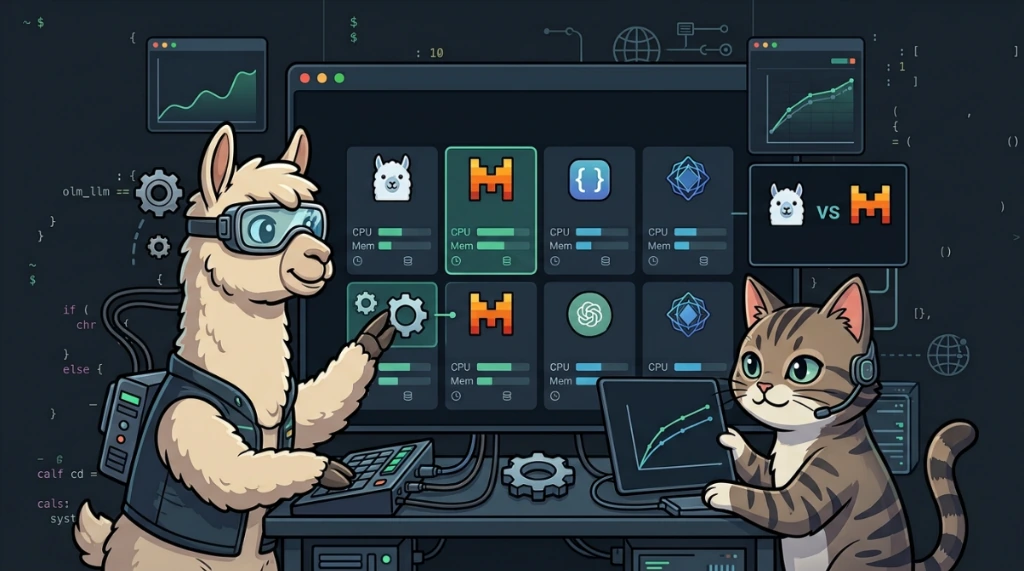
Tested Models Evaluation (Local TCO Evaluation):
- Llama 3 (Meta): Cohesive but excessively focused on natural language.
- Mistral: Balanced performance, focusing on lower L3 Cache CPU buffer consumption on x86 architectures.
- Qwen 2.5 (Coder): (The Underdog Win): Aggressively structured around software logic generative tokens, providing amazing alignment and delivering superior complex logic.
Operational Alert (The Physical Air-Gapped Bottleneck): The trade-off eliminates credit card charges but moves the bottleneck to RAM Swap. Architectures without dedicated graphics hardware (Discrete GPUs, NVIDIA with high VRAM) operating below 16GB of DDR4/DDR5 will suffer massive spikes that strangle the host kernel in RAM I/O. The agnostic engine hangs in the inference queue.
Post-mortem submission#
Extracting corporate dependency silos (pure GitHub/Anthropic APIs) through OpenCode integrations emulated strictly in the terminal with sockets pointed natively to Ollama, running quantized weights of the Qwen 2.5 Coder class, demonstrates solid tactical accuracy. This topology raises the threshold of individual workflows by injecting behavioral parity to dozens of Junior Engineers (virtual Dev-Pools operated in parallel under the command line) without incurring any corporate costs tied to token transaction counts.
Was this article helpful?
Leave a quick reaction to help prioritize future technical guides:
See also


This post is licensed under CC BY-NC.
Comments
Join the discussion below.
0 comments