
When building a SaaS product, primary focus typically revolves around delivering features quickly: onboarding flows, core dashboards, and business logic. However, during product scaling, an essential question inevitably surfaces: is an in-app account deletion button mandatory?
Evaluating the legal frameworks, user experience (UX) dynamics, and operational realities provides clear guidance, including how to handle users who request account deletion via email rather than using an automated dashboard button.
1. Legal perspectives and data privacy (LGPD / GDPR)#
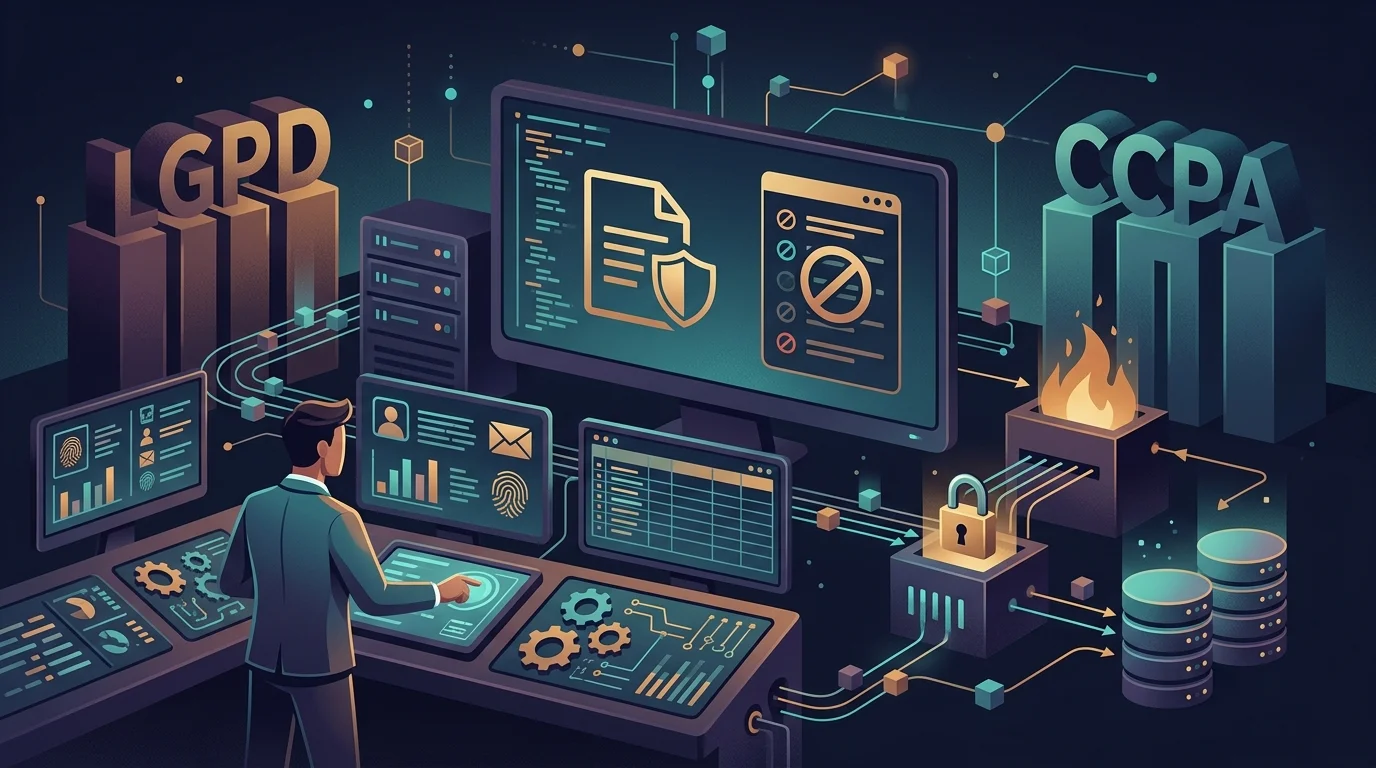
Under modern data protection regulations like LGPD (Brazilian General Data Protection Law) and GDPR, users are lawful data subjects holding statutory rights over their information (such as Article 18 under LGPD). When a user terminates their relationship with your platform, they have the legal right to request the deletion of data processed under their consent (Article 18, item VI).
If your application stores user names, emails, activity logs, and operational records, you act as a data controller. Failing to provide a clear mechanism for users to exercise this right introduces serious compliance liabilities.
Legal retention exceptions and soft delete strategies#
Physical deletion of entire database rows is not always immediate or legally permitted:
- Financial and tax records: Invoices, billing receipts, and payment transaction logs must be retained for legally mandated timeframes (often five years for tax audits).
- Database implementation: The standard architectural pattern is a soft delete (flagging a
deleted_attimestamp in the database) combined with personally identifiable information (PII) anonymization. Transactional history is preserved for financial compliance, but personal identifiers are wiped.
2. User experience (UX) and avoiding dark patterns#
Hiding the delete button or deliberately creating friction to prevent users from leaving is a harmful practice known as a dark pattern.
The consequences are consistently counterproductive:
- Friction and brand damage: Users who feel trapped in a platform frequently mark transactional emails as spam or publish negative public reviews.
- Trust and transparency: Knowing that canceling is effortless gives users greater confidence to subscribe and test your product.
- Constructive offboarding: An automated exit flow can include a concise, optional feedback step to help uncover why users churn.
3. Handling account deletion requests submitted via email#
If your application lacks an automated button and a user emails support requesting account termination, you are legally required to fulfill the request. Privacy regulations do not require requests to originate from UI clicks; support emails represent legally valid deletion notices.
Identity verification and security on email requests#
The primary operational risk with manual email requests is authentication. You must confirm that the sender genuinely owns the account before executing database mutations.
Recommended manual workflow:
- Reply to the request requesting explicit confirmation sent from the registered account email (noting that Article 19 of LGPD prescribes handling requests within 15 days).
- Clearly explain what data will be deleted and what financial records will be retained for legal compliance.
- Execute the database soft delete (
deleted_at) and PII anonymization. - Store support tickets and audit logs for compliance verification.
4. Why an automated deletion button remains the golden standard#
Receiving manual email requests does not replace the necessity of building an in-app deletion button.
Providing a self-service deletion option in account settings is industry best practice. Automation eliminates repetitive manual support tickets, triggers backend anonymization pipelines reliably, and respects user autonomy.
If a user sends an email request, the cleanest response is:
"Hello! For faster processing and enhanced security, you can delete your account directly from your dashboard under Settings > Account. If you prefer our team to process this manually, please confirm this reply."
Maintaining transparent control over data lifecycles in SaaS applications builds user trust while establishing clean compliance standards.
Conclusion#
In this post, I analyzed account deletion compliance through the lens of LGPD and practical SaaS architecture: implementing an automated self-service button as industry standard while supporting manual email requests with strict authentication, soft deletes (deleted_at), and PII anonymization — backed by audit logs for compliance verification.
Was this article helpful?
Leave a quick reaction to help prioritize future technical guides:
See also

This post is licensed under CC BY-NC.
Comments
Join the discussion below.
0 comments