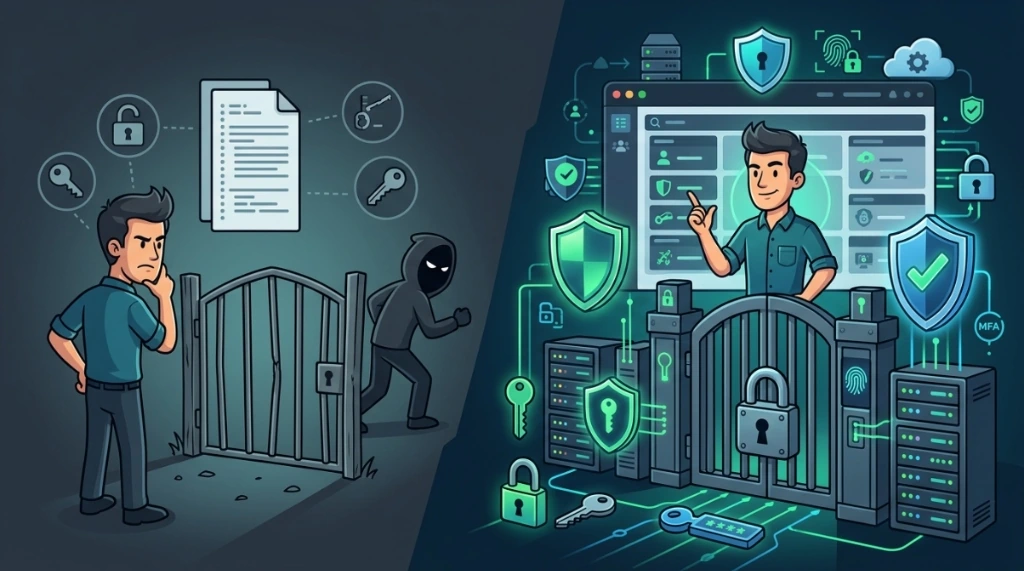
During intense operational phases, particularly complex infrastructure and service migrations, communicating with clients is just as critical as data integrity.
Recently, while finalizing a server migration phase, I reviewed a quick customer service response draft that highlights a core principle: textual clarity in a technical support ticket carries the same weight as syntax accuracy in a terminal script.
The initial unedited draft was:
"Não precisa se desculpar ficamos felizes e telo como cliente e companheiro neste tempo de migração."
While the underlying sentiment is empathetic, analyzing the phrasing closely reveals subtle grammatical errors and tone mismatches that generate unnecessary friction with clients.
1. Syntax analysis and communication friction#
Just as configuration files require exact syntax to prevent runtime crashes, client-facing text requires effortless readability:
- Missing separator (Lack of ACK):
- Issue: The absence of punctuation after the initial reassurance mashes two separate thoughts together.
- Impact: Reduces the immediate calming effect the response aims to provide the user.
- Grammatical and enclisis error (
e telovs.tê-lo):
- Issue: The Portuguese verb ter paired with the object pronoun o requires hyphenation and a circumflex accent.
- Impact: Unaccented spacing acts as an unexpected conjunction, forcing the reader to mentally re-parse the sentence.
- Register mismatch (
companheiroandtempo de migração):
- Issue: "Companheiro" introduces excessive informality for SLA-bound contractual relationships. Furthermore, "tempo de migração" is vague for describing a planned technical transition.
- Impact: Reduces the authoritative sobriety expected in high-level technical operations.
2. Communication refactoring matrix#
To structure the adjustments cleanly:
| Element | Identified Flaw | Root Cause | Refactored Solution |
|---|---|---|---|
| Initial punctuation | Merged sentences without pause | Missing break after negative | Clear full stop after validation |
| "e telo" | Orthographic / grammatical bug | Missing enclisis and accent | "tê-lo" |
| "companheiro" | Tone deviation | Overly casual phrasing | "parceiro" or "cliente" |
| "tempo de migração" | Semantic vagueness | Imprecise technical description | "processo de migração" or "transição" |
3. Practical refactored versions#
Depending on the specific context of the ticket, two approaches deliver strong results:
Option a: professional and empathetic (relationship focused)#
Ideal for reassuring the client and validating joint efforts:
"Não há necessidade de se desculpar. Valorizamos imensamente sua parceria e ficamos satisfeitos em tê-lo como cliente durante todo este processo de migração de infraestrutura."
Option b: concise and executive (stability focused)#
Direct, crisp, and focused on operational control:
"Agradecemos o contato. É uma satisfação tê-lo conosco nesta transição; seguimos à disposição para garantir a estabilidade do seu ambiente durante a migração."
4. The three-step response model: ACK → status → commit#
To maintain consistency during maintenance windows and incident response, I rely on this operational framework:
- Acknowledge (ACK): Validate and reset customer anxiety (e.g., "Não há necessidade de se desculpar").
- Status / Rapport: Reaffirm relationship value and current progress (e.g., "Ficamos satisfeitos em tê-lo como parceiro").
- Commit: Provide a firm commitment to environment stability and next steps.
Writing with precision in support tickets is not pedantry: it is a direct reflection of attention to detail. When I hold my code and infrastructure to rigorous standards, client communication must reflect that exact same standard of excellence.
Was this article helpful?
Leave a quick reaction to help prioritize future technical guides:
See also



This post is licensed under CC BY-NC.
Comments
Join the discussion below.
0 comments