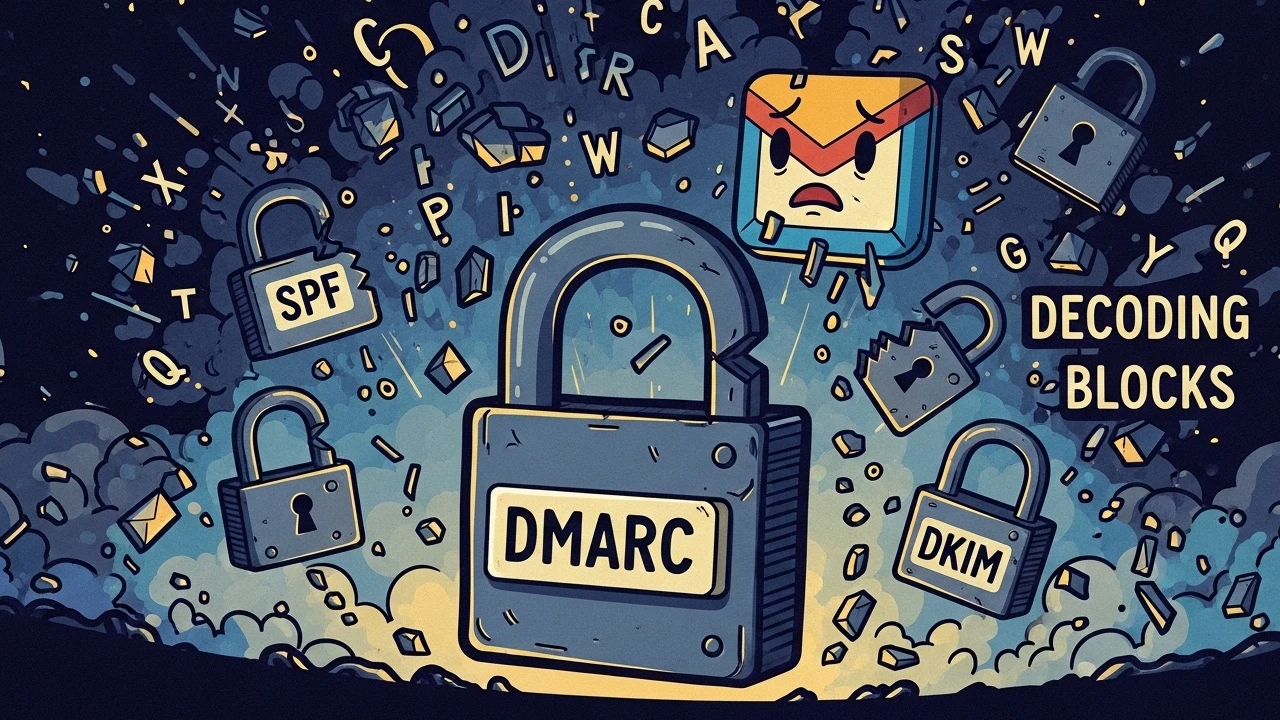
When Gmail rejects legitimate mail with generic errors, the root cause is often content reputation plus weak domain authentication, not raw infrastructure.
1) The symptom in logs#
Common block response:
421-4.7.0 Gmail has detected that this message is suspicious due to the nature of the content and/or the links within...This is a heuristic/behavioral block, not a simple DNS or mailbox issue.
2) Reputation layer: RBL and blocklists#
During investigations, RBL hits are also frequent:
rejected RCPT: ... is in an RBL: Blocked by: Malware.Expert - (SRBL SPAM List)This confirms that deliverability depends on sustained IP and domain reputation.
3) Why DMARC is decisive#
Without DMARC, large providers receive weaker policy signals on how to handle messages that look suspicious.
Example policy:
v=DMARC1; p=reject; sp=quarantine; adkim=r; aspf=r; pct=100; rua=mailto:[email protected]Quick meaning:
p=reject: reject authentication failures.sp=quarantine: policy for subdomains.adkim=randaspf=r: relaxed alignment.rua=: aggregate report destination.
4) Forwarding and SPF breakage#
Mail forwarding can break SPF because sender path changes between hops. Without proper SRS in Exim, SPF may fail for legitimate forwarded mail.
In this scenario, strong DKIM + DMARC alignment helps preserve trust.
5) Practical hardening checklist#
- Monitor delivery logs continuously.
- Revalidate SPF/DKIM/DMARC after DNS changes.
- Start DMARC with
p=none, then move toquarantine/reject. - Review body, links, and attachments on 421-4.7.0 events.
Modern deliverability is reputation plus authentication plus operations. SPF and DKIM are foundational, but DMARC is the policy layer that closes the trust loop with Gmail and other major providers.
Was this article helpful?
Leave a quick reaction to help prioritize future technical guides:
See also




This post is licensed under CC BY-NC.
Comments
Join the discussion below.
0 comments