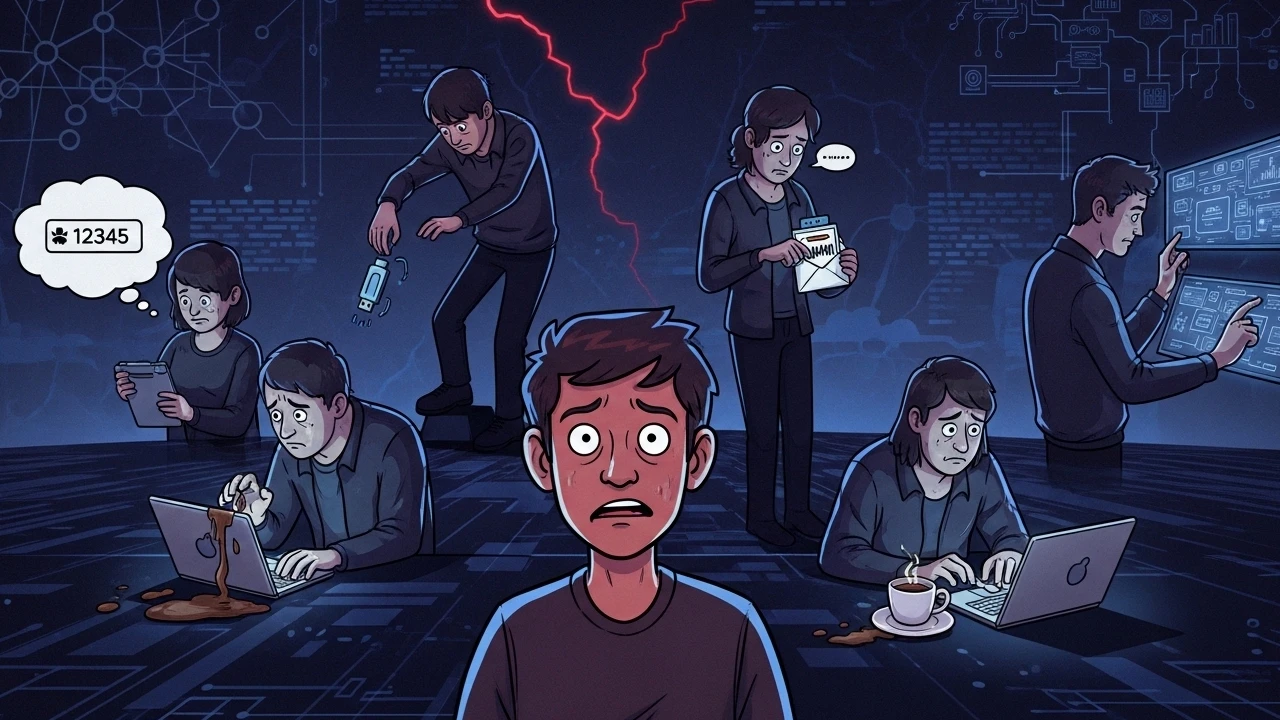
The human factor remains one of the biggest cybersecurity vulnerabilities. Even with constant technological advances, the Verizon Data Breach Investigations Report 2025 indicates that 60% of data breaches involve employee actions or mistakes.
A human cybersecurity error is any action, omission, or oversight that exposes the organization to digital risk, intentionally or not. From clicking a malicious link to unsafe personal device usage, a single mistake can compromise sensitive data.
Here are the five most common errors and how to mitigate them.
The 5 most common employee mistakes#
1. Clicking links and attachments without verifying the source#
Phishing remains one of the most prevalent attack vectors. Threat actors impersonate banks, vendors, or coworkers to trick users into clicking or sharing credentials.
- Mitigation: combine continuous awareness training with **email
security controls** that block fraudulent messages before users interact.
2. Reusing passwords across different systems#
Password reuse is highly dangerous. If one external service is compromised, multiple corporate accounts may be exposed.
- Mitigation: enforce long, unique passwords, adopt **password
managers, require MFA**, and regularly review/remove stale credentials.
3. Sharing sensitive information over insecure channels#
Sending confidential data through personal email, WhatsApp, or other non-corporate channels increases exposure and weakens governance.
- Mitigation: require secure corporate channels only, with encryption
and strong access control, reinforced by clear policy and training.
4. Ignoring alerts and security policies#
Users often ignore software updates or anomaly alerts because security feels like friction, which leaves exploitable gaps open.
- Mitigation: build a strong, positive security culture where policies
are practical, visible, and continuously reinforced.
5. Using unprotected personal devices (BYOD)#
Bring Your Own Device policies can significantly increase risk when personal devices lack updated antivirus, encryption, or endpoint hardening.
- Mitigation: implement clear BYOD policies, centralized device
management, and specific remote-access training.
Reducing human failure#
No technology can completely eliminate human error, but you can reduce it by treating users as part of the defense strategy, not the problem.
The most effective model is layered protection, combining:
- Awareness: practical training and phishing simulations.
- Technology: effective controls and MFA.
- Process: clear policy and regular access reviews.
Investing in awareness, technology, and integrated processes creates a resilient defense against most modern attacks.
Was this article helpful?
Leave a quick reaction to help prioritize future technical guides:
See also

This post is licensed under CC BY-NC.
Comments
Join the discussion below.
0 comments